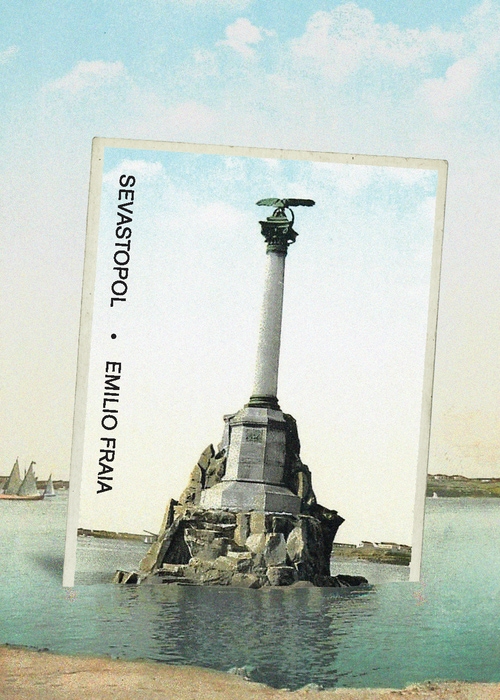
domingo, 5 de março de 2023

a bit gloomy, desolate, styled in a color palette that includes grays, greens, and violets

.
Texto da Melanie Broder na Public Books sobre o Sebastopol.
“Trunov was always breathing the leaden air of war—he was up to his neck in it—but war, the war itself,” Emilio Fraia writes, “never appeared in his paintings.” 

The line is a mini-essay on atmosphere, and a compelling case for the kind of fiction Fraia writes. As with other elements throughout his new collection, Sevastopol, the details here are less concerned with the art itself than with the absence it creates. Trunov’s resistance to looking at conflict head-on is an attempt to both cope with and get at the truth, and an acknowledgment of the futility of the exercise. 

Conflict is one of the building blocks of fiction, though often it’s merely scaffolding for more interesting ideas, images, or characters. Yet in certain stories—what may be called the fiction of avoidance, aftermath, or reverb—conflict is not present at all. Instead, the conflict is background, setup, the scuzzy noise behind the untidy complications of living. European American modernists may supply the most famous examples of this, but their kin stretch across the globe. Roberto Bolaño’s The Third Reich (2011) uses the provocatively named game of the title to set up a story of a German man who spirals into paranoia while on vacation. The filmmaker Wong Kar Wai, whose films often gesture at violent genre tropes, uses the markers of conflict as a way to indirectly examine desire and longing. Life is not always crisis; crisis is not always a singular moment. First there is the War, then there is the Peace, and while the former is essentially human, the latter is more psychologically complex. 

Fraia had Tolstoy in mind when writing Sevastopol, published in June 2021 by New Directions in a translation from the Portuguese by Zoë Perry. The stories draw their structure and titles from the Sevastopol Sketches, Tolstoy’s firsthand account of the siege of Crimea. The Sketches, considered a precursor to War and Peace, is an antiwar text, a three-part snapshot of a young writer’s disillusionment. 

What makes the Sevastopol Sketches a work of literature, and not just an act of witness, is that, at its core, it is concerned with storytelling. Its three tales, of a fallen city at three different moments in its decline, are three attempts to describe the indescribable, to find the right angle to name the horrors of war, when one is fully immersed in it, and losing. Fraia’s stories do the same, but for modern life. 

Take the first story of Sevastopol. Here, a mountain climber named Lena wanders into an art gallery and sees two photographs: “In one of them, a lightbulb hanging from a ceiling painted bright red. In the other, in black and white, a silver-colored sea under a single cloud. The bulb and the cloud were the same size and seemed to somehow talk to each other.” The matter-of-fact prose matches the ordinary phenomenon being described: the desire to extract meaning from an arrangement of objects, to interpret art. What makes the passage unusual is the author’s refusal to answer the question of whether the photographs are connected. He resists the novelist’s impulse to impose order, to make connections explicit, to bring them into conflict with each other. 

Instead, Fraia flips the question back to the reader: Which matters more, intent or interpretation? What if a juxtaposition of images in literature or art is just that—a chance encounter? What if the objects never actually meet? 

In a New Yorker interview that accompanies an excerpt of Sevastopol published in 2019 (notably, the first Brazilian short story to be translated into English for the magazine), Fraia said that “an air of conflict and defeat runs throughout—which also has to do with Brazil today, and the appalling election of the Bolsonaro government.” But Jair Bolsonaro, whom Fraia calls a “corrupt mafioso” in another interview, doesn’t appear in the stories. There are no scenes of death or destruction, only absence, disappearance. This atmosphere echoes the methods of the artist Trunov, whose art seemed wholly conflictless, even he was “up to his neck” in defeat and conflict. 

The connection between Fraia’s contemporary Brazilian stories and a war that ended in 1856 is not immediately apparent. Both are told in three parts: December, May, and August. The surface similarities end there. 

In Fraia’s “December,” Lena recounts a harrowing expedition to Mount Everest and the years of fallout afterward. “May” shifts the camera to Adan, a guest at a deserted country inn, as he tells the story of a family tragedy involving a guinea pig. In “August,” a young writer named Nadia describes her creative partnership with an eccentric playwright, Klaus, and their attempt to stage a play about a forgotten Russian painter named Bogdan Trunov. 

The characters’ suffering is, for the most part, internal. Their crises are lowercase, personal. And yet, there is something dreadful looming on their shared horizon. 

It’s difficult to pin down evidence that we are living in an era of decline, though plenty of writers have tried to do so. For Americans, the Trump era sliding into the pandemic has been a time of deep, destabilizing shame. The parallels with Brazil are clear: an unquestioned regional and cultural power, suddenly brought to its knees. 

But when you try to discuss it, to write about it, you end up talking about vague, sprawling problems that have been around forever: inequality, colonialism, despotism, racism. The interconnectedness makes the issues more confusing. 

In a talk hosted by the Brooklyn Public Library in June 2021, Fraia acknowledged that his book is not a novel but is meant to “be experienced like one.” A novel-like experience implies coherence. Usually that is achieved through the narrator, a single consciousness to filter the world through, or plot, a linear progression from A to Z. But Fraia instead chooses to blur and fracture his narrators, and to locate the coherence in something looser: atmosphere, mood, or—in today’s parlance—vibe. 

A vibe is, by definition, inexplicable. To say Sevastopol’s vibe is a bit gloomy, desolate, styled in a color palette that includes grays, greens, and violets, is both true and inexact. The vibe accumulates over time and amounts to something. But exactly what remains evasive, thrillingly open-ended. 

Fraia’s stories follow a fragmented and spiraling structure. They move fluidly through time and slip seamlessly from voice to voice, blending narrators and characters, present and past, fiction and reality. Certain images—a sky with a single cloud, a couple walking down a widening avenue, an uncanny stone bust—repeat across the nested tales, with slight variations. The only satisfaction lies in finishing the cycle and returning to the start, like watching a video on loop. 

Fraia is not the first writer to favor tonal unity over structural. Modernist writers famously used allusion, ellipses, and indirect speech to expose the psychological dissonance of the postwar era. The premise of Henry Green’s Partygoing (1939) is a choking fog that no one can see and everyone can feel. Virginia Woolf’s narrators slip between intrusive memories and their daily lives, as if past and present exist on a singular plane. Even writers who make use of formally traditional narratives, like Hemingway, are frank about their flirtations with nihilism (“Our nada who art in nada”). The only certainty in those works is uncertainty. 

A resurgence of modernist tactics may be apt for current-day Brazil or America. In “December,” Lena recounts her college years, and how she decided against a degree in international relations, because mountaineering was what “really mattered” to her: “And that’s how I put it: what really mattered to me. Which was true, because at that time what really mattered to me were the expeditions, days on the mountain, getting in touch with nature, the thinly veiled vanity of posting a photo at six a.m. surrounded by the ice, some vague idea of isolation and overcoming.” 

Zoe Perry’s translation is wonderfully elastic here, alternating between taut and slack, like a climber’s ropes. The set-phrase “what really mattered” rings bitter and hollow in Lena’s repetition. Sentence fragments build on each other, expanding as the list progresses; but instead of reaching a grandiose summit, the sentence deflates at the end: thinly veiled vanity, vague idea

Lena speaks to a larger disillusionment. It’s easy to imagine being in her shoes, brought up to believe that the pursuit of an individual passion would lead to spiritual fulfilment. The social media, the abandoned international relations degree, the sideways glance at the Romantic cure of using impersonal Nature to get outside oneself: all culminate in the storyteller’s flat detachment from former beliefs. There’s no solution here, no relief. 

As much as there is to be said about the literary traditions that Sevastopol fits into, I was more immediately struck by its similarities to visual media, in particular, film. Critics deem some books “cinematic”; it’s never been clear to me whether this is a compliment or an insult. The word conjures up Freytag’s pyramid: that rickety old roller coaster of rising action, climax, and denouement. Forced conflict, the cheap thrill of fake fear. Feasts of gunfire and car crashes and sex. Getting to the end and letting viewers off the hook, releasing them to their homes and families, to a good night’s sleep. Are you not entertained? 

But what if “cinematic” instead echoes Lena’s observations of the photographs? Perhaps a cinematic book is one that simply lets its images be. It tells the reader: you sequence them, and decide what happens in between. If you want, let them stay isolated, shifting slightly toward and away from one another, vibrating occasionally. 

Great movies play with this liminal space, this room for imaginative fill-in-the-blank. Watching the new restoration of Wong Kar Wai’s Chungking Express earlier this summer, I was struck by how much the opening sequence relies on viewer expectations. A shaky camera follows a mysterious woman in a blonde wig through a tunnel-like structure; she moves quickly and looks back once, with the intent to lose whoever’s on her tail. Along her path we glimpse other figures in blurred shadow; a man eating at a plastic fast-food table, a child ordering sweets from a stand. The blonde gets into an elevator, enters a cramped bedroom full of men, and the scene cuts to chimneys blowing smoke across the night sky. Jilty and enigmatic, the setup is a play on and ode to genre film. And yet, the thriller we are preparing for never quite materializes. 

Instead, we get an unexpected love story. The woman botches a drug smuggling, kidnaps and returns a child, and, eventually, has a shootout with a seemingly random stranger, whom she kills. But at her wits’ end, she walks into a bar. This is when the story actually begins. At the bar she is approached by a sad-sack policeman known only as 223, who is drinking to forget a breakup. They spend the night together, not quite connecting per se, but not falling further into despair either. They separate the next morning. 

Chungking Express is a story about fracture; about building oneself back up after personal disaster. It’s set in the transient space of the Chungking Mansions, a crumbling, midcentury commercial tower in the bustling Tsim Sha Tsui area of Hong Kong that boasts a daily foot traffic of 10,000. Full of hostels and cheap eats, it was once the landing place for many new arrivals to the island—the kind of place where one could shed her old self and start fresh, as the assassin does when she dons her blonde wig, or as the policeman does when he walks into the bar. 

It’s also the perfect location for serendipitous encounters. “Every day we brush past so many other people,” 223 says in the opening voice-over: “People we may never meet, or people who may become close friends.” His tone is wistful; as high as the potential is for romance in such a setting, the same goes for missed connections, or even violence. No one knows this better than a police officer. In a crowd of strangers, you could meet a potential lover as easily as your potential killer. 

The movie was released in 1994, amid the colonial handover of Hong Kong from Great Britain to China. In the film you can see the city’s shifting identities; in the bar scene, 223 tries to pick up the assassin in Cantonese, Japanese, English, and finally Mandarin, before she answers him. Brands like McDonald’s are prominently displayed; the largely African and Indian sellers at the mall hawk electronics, luggage, and homestyle cooking. The policemen are never seen policing; it’s easy to assume an uneasy peace between the disparate factions. 

The second half of the film focuses on a different love story, featuring another lonely policeman, Tony Leung’s iconic 663. This time, the thriller premise is dropped. Instead, we are drawn into more intimate spaces. 663, like 223 before him, frequents the Midnight Express, a kebab shop owned by a Hong Kong local, who employs his niece Faye behind the counter. Faye is a dreamy sort, who likes to blast the Mamas and the Papas and the Cranberries as she wipes down the grimy surfaces. She eventually becomes obsessed with 663, taking advantage of the handoff of a key to break into his apartment, clean it, and replace all his old belongings. Before he even notices her effect on him, Faye assumes a new identity and leaves for America. After her departure, 663 pines for her in a California-themed bar while sipping a Mexican beer. 

Between Faye and 663, the assassin and 223, there is a sense of a wish unfulfilled, even after their happy unions. Perhaps this is the dissociative quality of globalization: the sense that we could be anywhere, and anyone, that we are watching our lives play out in multiple locations, multiple timelines at once, and the freedom and loneliness in that. 

Maybe what troubles them is a broader question. Amid rapid historical and political upheaval, will what comes next really be better than what came before? Or maybe it’s simply the sadness baked into any love affair, due to the inevitability of grief. 

Maybe this is our leaden air of war. It’s the tumult of personal and political constantly colliding, giving us new information, subverting the old stories we’ve always told ourselves. 

Of the three ethereal stories in Sevastopol, “August” is the most concrete, due to a lived-in sense of place. São Paolo, where Fraia was born and still lives, factors largely into the story. Klaus is a lonely German émigré living in a rundown flat near the city center. He and Nadia regularly dine at the “musty trattoria[s]” of Bixiga, the city’s Little Italy. They spend long nights together, doing nothing. Nadia describes them: “Drunk, we’d roam the streets of República, along Avenida São Luís, past the gray boulevards, the tangled nests of wires on telephone poles, the guys giving blow jobs in dark alleys, the statue of an Indian whose shadow bore down on the transvestites who gathered at Largo do Arouche to smoke joints. Sometimes we stopped and smoked with them.” 

In these quick cuts, Klaus and Nadia move frantically, yet languorously. They hurry along until they stop, and the scene dissolves in smoke. Their activities are intentional, yet purposeless. They are acting like artists, absorbing their surroundings, making themselves a part of the shadow-city. But Nadia, like Lena before her, doesn’t quite believe in what she’s doing. The streets are dim and dull to her; a series of unrelated images. They could be anywhere and thus are nowhere. She is numb. 

Nadia’s conflict is neither internal nor external, but somewhere between. Fraia’s storytelling, like Wong’s, gestures at a collapsing of the self. Thanks to factors beyond our control—transfers of power, the internet, globalization’s totalizing grip—we are constantly slipping in and out of consciousness, inhabiting minds and lives that may or may not be our own. Our internal realities permeate our external ones. We watch helplessly as our selves divide and disperse, transformed into particulates, microscopic droplets floating in the air. We try to find the right story to hold us all together, but no single narrative seems to fit. All we can point to is whether the vibe is good or off. 

When the tools of fiction no longer serve us, we can discard them. Instead of seeking relief in a singular order—in the resolution of conflict—perhaps we ought to adjust our expectations. Perhaps we ought to stand quietly in the gallery together and stare at the white space, locating the truth in our collective imagining, without ever pinning it down.
.

segunda-feira, 8 de agosto de 2022

onetti, mergulhador

Ensaio publicado na The Paris Review. Sobre Juan Carlos Onetti, Michel Leiris, mergulho, Ubatuba e vida submarina. Tradução da Zoë Perry.


I first read the Uruguayan writer Juan Carlos Onetti in December 2007, when I spent three weeks in the hospital due to an appendectomy gone wrong. Between doses of antibiotics, I asked my father to bring me a book that had just been published, of Onetti’s complete short stories. Before long, I came to one entitled “Convalescence,” which seemed appropriate given my situation. A woman is recovering from an illness in a hotel by the sea. Onetti doesn’t tell us what the illness is. A man keeps calling her on the phone, making threats, insisting she return to the city. I knew it might not be the best idea to read Onetti while laid up in a hospital bed—he’s not exactly the most upbeat writer. But the feeling that came over me as I turned the pages was one of joy.

Back then, I used to go on diving trips with a couple of friends. I was really into it—getting away from São Paulo and heading down to Ubatuba or some other town on the coast, spending the weekend in the water, going out at night to drink acai juice and chat in a sandwich shop or some beach bar, wondering what the next day’s adventures had in store. As my friends exchanged long emails, hammering out the details for their next so-called expedition, like a pair of Jacques Cousteaus setting sail on those windy, unpredictable mornings in the silvery sunshine of our little patch of lush South American coastline, a nurse was changing the dressings on my right abdomen and adjusting the IV in my arm.

I had had two general anesthesias, an infection, two operations. Throughout my entire recovery, I kept reading Onetti. Rather than revolving around a desire to pick apart and reconstruct meaning, these stories seemed to be aimed at revealing something else. It was as if Onetti were saying to me, It’s impossible to have access to everything, a narrator may actually exist to throw us off, and there’s always something we can’t see.

Soon, I had a favorite: “Esbjerg by the Sea.” The narrator situates the reader right off the bat: a couple, Kirsten and Montes, walks along the docks of Buenos Aires and watches the ships depart. The narrator claims to have heard the story, “without understanding it,” one morning when Montes showed up, humiliated, and confessed to stealing from the narrator. At the narrator’s office, Montes, “a pathetic man, a bad friend, a bastard,” explained that he’d concealed a series of bets, planning to cover them himself, so that he could raise money for Kirsten to travel to her native country, Denmark. But his plan didn’t work, and now he was unable to pay back what he’d lost.

“I think he told me the story,” the narrator says, “or almost all of it, that first day, Monday, when he came to see me, cowering like a dog, his face green, revolting, cold sweat shining on his forehead and down the sides of his nose.” More than just signaling the narrator’s one-sided perspective—“I heard the story, without understanding it”; “I think he told me the story, or almost all of it”—Onetti makes this lack of transparency, and everything the reader can’t see or understand, the secret theme of the story.

.
Esbjerg is a seaport town in Denmark. In the story, it’s presented as an obscure place. Kirsten is always miserable, but she won’t say why. She fills the house with photographs of her home country, landscapes with cows and mountains. One day, letters start to arrive from Denmark. Montes doesn’t understand a word of them, and Kirsten says that “she’d written to some distant relatives and these were their replies, though the news wasn’t very good.” There’s a sentence, in Danish, that Kirsten keeps repeating, and this is what impacts Montes the most. He doesn’t understand those words (neither does the reader), but something in Kirsten’s voice makes him want to cry. “It must have been, I think, because the sentence he couldn’t understand was the most remote, most foreign, and it came from the part of her he didn’t know,” the narrator speculates.

After Montes’s plan goes awry, Kirsten begins leaving the house constantly, never saying a word. One day, Montes follows her. Kirsten goes to the port, where she stands for hours, stiff, looking out over the water. The story ends with Kirsten and Montes, side by side, watching the ships depart, “each with his or her own hidden and distinctive thoughts”: a feeling that “each is alone, which always turns out to be surprising when we stop to think about it.”

In the end, the couple’s story hangs like a veil of murky water between us and the narrator, someone who ultimately just makes everything more unclear. What sets in is a feeling of being at the bottom of the ocean, surrounded by schooling fish, octopuses parading their tentacles in the dark, and Onetti saying, You’ll have to excuse me, but you won’t be able to see much here, even up close it will be impossible to make out much of anything besides the uncertainty of another’s thoughts, and you won’t get any satisfactory answers.

.
“When moving, use extra care not to disturb the sediment” is one of the commandments of sport diving on shipwrecks. If a diver’s fin grazes any surface of the boat, it will stir up silt, muddying the water. The same goes for cave diving. Visibility can be reduced to almost zero, so you have to use ropes and cables and be prepared to make a blind ascent. In the Coral Sea, off the coast of Australia, it’s the opposite: the waters there are some of the most crystal clear in the world. Sixty meters of visibility, lending an illusion of total control over your surroundings.

What governs visibility underwater is a concept in physics known as opacity, the measure of how penetrable or impenetrable a given medium is to a wave, electromagnetic or otherwise. For example, an opaque medium doesn’t allow light to pass directly through it; it absorbs, refracts, or reflects. Consequently, the intensity of the beam of light is reduced, and it fails to reach the other side. On Ilha das Palmas, an island south of Ubatuba, underwater visibility is about eight meters, and the seabed is rocky. Thanks to ocean currents, the area is frequently visited by a variety of fish: moray eels, parrotfish, starfish, and sand dollars. That was where we used to go, dreaming of the Coral Sea or the Andros Barrier in the Bahamas, where we’d finally be able to see everything.

I encountered this hope for seeing things clearly in the work of the French surrealist Michel Leiris, whom I’d also started reading at that time. Compared with Onetti, Leiris was a much different diving instructor, so to speak. Leiris promised so much more, with the confidence of someone who’d take us to see reef sharks and dolphins swimming in infinite blue waters. Leiris, who was Onetti’s contemporary, said that literary activity’s “only justification is to illuminate certain matters for oneself at the same time as one makes them communicable to others.” In the essay “De la littérature considérée comme une tauromachie” (“Literature Considered as a Bullfight”), a sort of introduction to his confessional autobiography, he wrote that he “intended to elucidate certain still obscure things for which psychoanalysis had attracted my attention when I experienced it as a patient.”

Words like illuminate, communicate, and elucidate gave an idea of how Leiris’s thought interacted with his language (clear, not overdone, ostensibly nonliterary). But while Leiris had wanted to “elucidate,” the interaction between Onetti’s ideas and his language (murky, disjointed, nonlinear) produced an altogether different effect: the search for answers or clarification didn’t exist. The stories I was discovering from my hospital bed seemed to lead the characters (and the reader) into even greater darkness. We could think about our world, a world of shipwrecks and wasted dreams, where visibility, for the most part, was brutally low. And how might we give shape to this world? How much could we really know someone or even ourselves? How might we dive into those murky waters, more saturated with sediment by the day, and communicate this state?

My friends kept exchanging emails, listing dream destinations, equipment, water conditions. It’s important to note that opacity is not absolute—that is, what is opaque for some wave frequencies can be translucent for others. There’s a kind of glass that is transparent to normal light waves (you can see through it) but completely opaque to ultraviolet waves (the ones that burn your skin on a beach in the Bahamas or the Australian Coral Sea). Generally speaking, this has to do with the interaction between the frequency of the medium and the frequency of the wave that’s trying to travel through it. Depending on the degree of syntony between these frequencies, the wave will either pass through or be stopped in its tracks.

One of Leiris’s mantras is to “reject all fable” and “admit as materials only actual facts, and not only probable facts, as in the classical novel.” Leiris wanted to set in motion a kind of realism that was “not feigned, as in most novels,” but made up of “things experienced and presented without the least disguise.” In some way, this felt connected to another world, one that would show itself more and more over the coming years: autofiction, stories where the use of real or biographical events was a value in its own right, an interest in private life, diaries on public display, confessional storytelling, Instagram stories, our painstakingly psychoanalyzed life (the epic of subjectivity), the assumption that there’s a correlation between our perception of the world (“our truths”) and the world itself, the desire to “make clear,” to understand oneself, to see how things “really” are; the belief in the illusion of transparency—when we go to update our Facebook status, the little box prompts us to share, asking, “What’s on your mind?”.

.
While there may be many paths that lead us to transparency (a watering down of Leiris’s confident gesture), Onetti is a kind of Zen master of opacity, a diving instructor who takes us to spots where we can see very little. His own image reinforces this: lying in bed, smoking, scribbling on bits of paper, bedsheets reeking of gin. In Onetti, the entrance to this murky-watered world isn’t through the fantastic or the magical, like some of his Latin American contemporaries. Or at least, not only that. His most unforgettable and sorrowful stories—“A Dream Come True,” “Most Dreaded Hell,” “The Face of Disgrace”—are realist narratives that seem to crush the modern hope of seeing everything. There’s a play between the affirmation and negation of reality—a subterranean current that seems to connect his work to Bolaño’s short stories. This is mainly because in Onetti’s stories, these mechanisms of memory, invention, and partial ignorance are contained within what is being told.

When we read, we’re often looking for things to be made clear. We want that beam of light to reach the other side. We want to see and to understand, both of which give us an unmistakable feeling of comfort and happiness. This is what makes us forge ahead in a novel: the search for a reason, a rationale, a purpose. Life, in general, also works like this. But inevitably, there are things we can’t see. All along the way are blind spots, hazards, twists and turns. Like those mornings and afternoons spent diving—when we were immeasurably happy and then all of a sudden, out of the darkness, came some staggering revelation—everything happens somewhere between opacity and transparency. We can compare and contrast these categories for all practical purposes, but the truth is that one does not exist against the other; unbeknownst to us, they’ve been coexisting the whole time. It may seem paradoxical, but Onetti, despite the blurred timelines of his stories—or perhaps because of them—is a transparent writer. 

He is transparent in his endeavors to produce opacity. His writing lets us see precisely what we cannot.

*

Emilio Fraia was born in São Paulo in 1982. His English-language debut, Sevastopol, translated by Zoë Perry, was recently published by New Directions in the U.S. and Lolli Editions in the UK. Fraia was named one of Granta’s Best Young Brazilian Writers. In English his fiction has appeared in The New Yorker, Grand Journal, and Two Lines 19: Passageways.

Zoë Perry’s translations of contemporary Brazilian literature have appeared in The New Yorker, Granta, Words without Borders, and The White Review. She is a founding member of the Starling Bureau, a literary translators’ collective, and was selected for a Banff International Literary Translation Centre residency for her translation of Emilio Fraia’s Sevastopol.

All Juan Carlo Onetti quotations from A Dream Come True: The Collected Stories of Juan Carlos Onetti, translated from the Spanish by Katherine Silver and published by Archipelago Books. 

sexta-feira, 3 de junho de 2022

sevastopol (4)

.


Este mês, na Noruega, pela Solum Bokvennen.
.

segunda-feira, 29 de novembro de 2021

vírgula, uma controvérsia

Na World Literature Today, escrevi sobre a vírgula: "For linguist and Columbia University professor, John McWhorter, the comma is becoming redundant in the digital age. According to him, we could take commas out most of the texts we read “and would probably suffer so little loss of clarity that there could even be a case made for not using commas at all”. But it’s not just the internet that agrees with McWhorter; Gertrude Stein considered commas “servile and with no life of their own”, and the Fowler brothers noted in their 1906 book The King's English: “Anyone who finds himself putting down several commas close to one another should reflect that he is making himself disagreeable, and question his conscience, as severely as we ought to do about disagreeable conduct in real life.” A few years ago, British writer and essayist Pico Iyer came to the rescue of the aforementioned punctuation mark—which, according to scholars, appears in texts at least three times more often than the period, and five times more often than the semicolon. In an interview, Iyer said that contrary to what Professor McWhorter says, we need commas now more than ever: “precisely because punctuation is falling out of our text messages and e-mails, and because we are more in need of a pause than ever before”. According to Iyer, part of the beauty of the comma is that it offers us a break. Without the comma, he muses, “we will lose all music, nuance and subtlety in communication and end up shouting at one another block capitals.” Discussing commas stirs up tempers and, since the time of Saint Jerome—who in the 5th century AD devised the first system of dividing up texts, per cola et commata—sets us before our most intimate pauses and hesitations. Saramago would not be possible without the comma. New Yorker founder Harold Ross put a comma in the line “After dinner, the men went into the living-room” so that the men could have time to push back their chairs, stand up, and then head to the living room. And the sad irony of the opening sentence of Disgrace, by J.M. Coetzee, and its cold, guarded, emotionally distant protagonist, wouldn’t exist if not for the comma: “For a man of his age, fifty-two, divorced, he has, to his mind, solved the problem of sex rather well.” In 2001, Pico Iyer wrote an article for Time magazine in which he claimed discussing commas is like discussing love: “in love the smallest things matter desperately, which is why lovers pay such attention to the tiniest marks on the page,” he says. “And no one scans a letter so closely as a lover, searching for its small print, straining to hear its nuances, its gasps, its sighs and hesitations, poring over the secret messages that lie in every cadence.” There is a scene in Spike Jonze's film Her about love and commas. The story takes place sometime in the future, when Theodore (Joaquin Phoenix) falls in love with an operating system, Samantha (played by Scarlett Johansson, in a husky, sensual voice). In the scene, the couple argue, and during the fight, Theodore angrily asks his robot girlfriend why she sighed while she was speaking. “Why do you do that? It’s not like you need oxygen or anything.” Apropos the comma, in 1879 Oscar Wilde wrote in his diary: “In the morning I took out a comma, but on mature reflection, I put it back again”."
.

segunda-feira, 8 de novembro de 2021

anti-story

.
Erin Bloom sobre o Sevastopol, na Full Stop Magazine.
.

“People always tell the same stories, even when they try to tell new stories." 

Ironically, or not, this memorable line appears in the third and final story of Sevastopol, Emilio Fraia’s collection of short fiction. In an interview about the collection, Fraia, a Brazil native, explained he is “less interested in the reality of objects than in their representation.” And while much of the book’s action takes place in Brazil, Fraia offers a counterintuitive take on authorial authority: “I didn’t want the fact that I’m familiar with a certain world to matter, to change the way I’d write about it.” Both these quotes, not to mention his actual work, speak to a novel approach to acquiring, representing, and thinking about knowledge. I am not sure if there is a general expectation that stories in a collection will be in conversation with one another, but Fraia’s are. And if I may be audacious, I think their connective tissue can be summed up with one word: epistemology. But that word is also a question. 

The three stories have minimal but intertwined titles: “December,” “May,” and “August.” The first one is foggily about a trailblazing Brazilian female mountain climber whose fall on the way down Mt. Everest leads to the amputation of her legs and, perhaps more to the point, becomes famous for her TED talk about facing and overcoming setbacks. This narrative denouement, in which the narrator turns her journey into a packageable story to wrap up the actual short story, is ambiguous and ambivalent. Our hiker-narrator evaluates her progress: "What had I done with my story? To be honest, I did what people do all the time. Tell stories, retell them, freeze them in time, try to make sense of them. This is me, I exist, this is my story, this happened to me, I suffered, I fought, I kept going, I made it, the world needs love and justice, inspiration is the path forward, it’s the first step towards making a wish come true. And history is repeated until everything gets erased, and we no longer know what is what." 

It is interesting that the hiker-narrator never explicitly says there is anything wrong or even technically false with how she has presented her experience. Rather, it feels as if her narrative addresses some kind of primitive need which, while real enough, does not exactly lead anywhere. This need, Fraia implies, is as vestigial and inert as the hollow ambition that makes Lena want to climb in the first place: “What motivated me, I thought, was a desire to prove to myself, and to as many people as possible, that I was different, that I could do things that nobody, or almost nobody else, could do.”

What seems to intrigue both the narrator of “December” and Fraia is the idea of insignificance as a type of telos. The narrator reflects, “The beauty of climbing is that it’s pointless. It has no meaning, it doesn’t hide a meaning, it’s a person and a wall — that’s it.” And towards the very end of the first story, this pointlessness deescalates into active obliviousness, as Lena looks back in history for an amputee role model: “When asked how he coped, one of the thousands of soldiers maimed in the Crimean War said: the chief thing is not to think. If you don’t think, it’s nothing much. It mostly all comes from thinking.”

“May” is about a shadowy figure who comes to stay and then disappears from a remote hotel owned by another shadowy figure. The story describes the narrative ramblings of a devastated woman at a church-basement support group meeting: “She started to talk about her husband who had died, her son who’d left home, and then segued into a story about the ocean... Then she went back to talking about her husband and son. And, once more, to talking about the sea.” Rather than these disparate threads coming together, the narrator informs us that the woman’s “stories ran in parallel, never meeting.” The sentiment could apply to the short story collection as a whole, but also to its individual pieces. The elements — people, themes, plots — within a single story do not quite converge, let alone align or overlap. This occurs in “May,” where several characters literally come together at a remote hotel only for their stories to spin off in different directions, physical proximity and shared space being incidental to the invisible, un-integrated trajectories of their individual stories. Nilo, the owner of the hotel, “thinks that men’s stories are all one and the same.” At first, that seems entirely opposite to the idea of stories running in parallel. But are the two sentiments in fact opposed? 

There is something anti-story in every story, where the force pushing towards narrative resolution (or at least compromise) is challenged by a slightly ethereal centrifugal drift which slows, and maybe even reverses, that centripetal approach. For example, Lena the hiker organizes to great acclaim the trauma and emotion of her fateful climb of Mt. Everest into a coherent story yet grows more confused about what actually happened to her, what it means, and how she remembers it. This sense of internal contradiction is further reflected when Fraia writes “with great hope also comes a great lack of hope.” In this collection, approaching something is in fact a form of alienation and avoidance.

The third and final story, “August,” is the best and quite excellent. It also is easily the most Russian — making good on the promise of the book’s title. “August” has the most definite and persistent plot. It follows the unusual and strangely affecting duo of young and listless Nadia and ineffectual past-his-prime Klaus as they work together on an utterly irrelevant if not exactly underground play about the life of 19th century Russian painter Bodgan Trunov. Isn’t that already pretty funny? 

But “August” examines the dominant theme of skepticism with traditional narrative on several levels. First, the story emphasizes Trunov’s apparent indifference towards what one would expect to occupy the center of his perception and lived experience: “What’s most fascinating, Klaus said, is the way Trunov was always breathing the leaden air of war — he was up to his neck in it — but war, the war itself, never appeared in his paintings.” The Russian subject of Klaus’s play was always focusing on the story lurking around, looming over the “actual” story. This tendency lives on in 21st century Brazil in the form of Klaus, a failed playwright, who presents his “researcher” Nadia with an idea for a “rousing scene, which, of course, was far from rousing, because what Klaus liked was anything but action. He liked what he called the lingering moment.” This reminded me of Martin Amis’s point about the limits of writing outside of temporality, that it cannot really be done because it implies the breakdown of the relationship between the “beginning” and “end” of a sentence. If you transcend or reject stories and the idea of moments progressing rather than just lingering, where does that leave you with people? 

That is a big question and not one that Fraia, let alone Klaus, is necessarily interested in answering. But perhaps something of a solution is to be found in the story’s comic irony. Klaus, in his role as director-playwright, is constantly getting the story wrong. Nadia explains that Klaus asked her to be his researcher for the Trunov play because “he’d noticed my interest in Russia, which wasn’t entirely accurate. I didn’t know the first thing about Russia.” Klaus then later wants to introduce her to a man he has a crush on so that Nadia can evaluate him because he thought they “had similar tastes . . . He could not have been more mistaken.” 

Lethargic as it can seem, an unbreakable commitment to living by a whimsical but serious, persistent but un-rigorous feel for things qualifies as an artistic aesthetic, as a point of view capable of creating space for new possibilities, in large part because it subordinates reality to admittedly vague ideas. Your ideas with unclear provenance and your place with unclear context begin to function as a jerry-rigged approach to epistemology. 

With respect to place, the common ground for the three stories is Brazil. But I would argue there is only vague recognition and reconciliation with place in “August.” Klaus mistakenly thinks Nadia is interested in Russia because he read a short story of hers which she had set in Russia, specifically “Moscow in the eighties.” But, Nadia explains, “my story, to be perfectly honest, could have taken place anywhere in the world.” Is it any surprise this placelessness trickles up and out of her fiction and she finds herself research assistant to a playwright who hates “action” and loves “lost people”? 

I think not.

In a bizarre story that follows two eccentric characters going nowhere fast, working on a play that is dead even before its disappointing arrival, there is something rather moving in Nadia’s rewrite. After spending all this time with Klaus on this insane, inert, and esoteric play, she begins to think about “the big picture, about my generation.” This pondering leads her “back to the story I’d been writing.” Perhaps Fraia is correct when he writes that stories do not “work” but merely iterate. But when Nadia revises her story to take place “not in Russia but in a dreary town on the southern coast of Brazil, a town with gusty mornings and white skies, with shops selling beachwear, floaties, Styrofoam boogies,” it is clear that only narrative has made it possible to do the hard work of being where you are. To return to the dominant theme of epistemology, narrative may not offer anything that is — in the literal sense — positive. The right question, however, might not be whether a story is “new” or the “same” but rather whether it is evasive or confrontational. To participate is to confront — a time, a place, a person, a feeling — and aesthetic participation should never be confused with what, despite a surface resemblance, is its anthesis — artistic passivity. Thus, when Fraia’s Nadia writes of the narrator of her own story, “For a moment, she seemed to catch a glimpse of herself from the outside,” we know the sharp shock of distance and outside vision have triumphed over the false knowledge of blind placelessness and solipsistic interiority.
.

terça-feira, 19 de outubro de 2021

um tapete

"Outro dia, lembrei-me de uma vez em que você veio aqui e, logo que chegou, pôs-se a vasculhar todos os armários à procura de um tapete sardo que queria pendurar na parede do seu porão. Deve ter sido a última vez que o vi. Eu estava nesta casa havia poucos dias. Era novembro. Você zanzava pelos aposentos e vasculhava todos os armários, que tinham acabado de montar, e eu andava atrás de você, me queixando de que você sempre levava embora os meus objetos. Você deve ter encontrado o tal tapete sardo, porque aqui ele não está. Também não estava no porão. De qualquer modo, pouco me importa aquele tapete, como pouco me importava na época. Lembro-me dele talvez por estar ligado à última vez em que o vi. Lembro que, ao ficar brava e protestar com você, senti uma grande alegria. Sabia que meus protestos suscitariam em você um misto de alegria e aborrecimento. 

Penso agora que esse era um dia feliz. Mas, infelizmente, é raro reconhecer os momentos felizes enquanto estamos passando por eles. Nós os reconhecemos, em geral, só à distância. Para mim a felicidade estava em protestar e para você em vasculhar os meus armários. Também devo dizer que perdemos naquele dia um tempo precioso. Poderíamos nos ter sentado e interrogado reciprocamente sobre coisas essenciais. É provável que seríamos menos felizes, ou melhor, seríamos talvez muito infelizes. Porém, eu agora lembrarei esse dia não como um vago dia feliz, e sim como um dia verdadeiro e essencial para mim e para você, destinado a iluminar a sua e a minha pessoa, que sempre trocaram palavras de natureza inferior, jamais palavras claras e necessárias, ao contrário, palavras cinzentas, gentis, flutuantes e inúteis."

Caro Michele, Natalia Ginzburg, trad. Homero Freitas de Andrade 
.

sábado, 7 de agosto de 2021

sevastopol (3)

.


Em novembro, na Suécia, pela Bokförlaget Tranan.
.

sexta-feira, 2 de julho de 2021

três leituras

Benjamin Moser na newsletter Urubuquaquá

"I’m excited to announce that New Directions, where I’ve been publishing the works of Clarice Lispector for all these years, has just published Sevastopol by Emilio Fraia. If Graciliano Ramos describes the old, romantic Brazil of a century ago, Emilio Fraia describes something much more like the country that exists today—the country and people I know: people who resemble Lampião and Lieutenant Bezerra far less than they resemble middle-class people anywhere else.

It’s a weird book: three connected stories loosely based on the Sevastopol Stories of Tolstoy. It’s weird because the stories are connected—but how, exactly? And it’s weird because the stories themselves are constantly wrong-footing you. You think you know what’s happening, and then suddenly you realize you don’t. I read the book twice—once when it came out in Portuguese, a few years ago, and once more when I got this new translation, by Zoe Perry. (The translation is excellent, by the way.) I thought I understood it the first time. The second time, I was sure I didn’t. That’s why, though it’s a short book, it’s been bouncing around in my head these last few weeks, and why I’m thinking about reading it one more time.

To give you a taste: one of the stories was published in The New Yorker a couple of years ago, and Fraia has just published something new in The Paris Review, related, kind of, to another one of my favorites, the Uruguayan writer Juan Carlos Onetti. 

.
Na Southwest Review, Marshall Shord: 

The characters in Sevastopol, Emilio Fraia’s brilliant triptych of stories, are as familiar with the sense of what-could-have-been as with the ache of a phantom limb. Loss defines each of them, and, in a way, is also what keeps them going. They haunt their own lives, seeking out what they have lost, not because they think that finding it will bring back all that has gone, but because they can think of nothing better to do. One way to define a ghost is as a compulsion that has outlived the one who bore it.

Smuggled in under the cover of these stories of, as one character puts it, “lunatics and lost people,” is a portrait of Brazil in precipitous decline, riven by racism, inequality and violence. Fraia provides the reader with only a few outright glimpses of this covert narrative, preferring instead to dress it within the specific context of each story. At the same time, he deploys recurring images—a demon seeking to escape its earthly prison, streets too wide to cross—and a uniform atmosphere of dread to bind the stories into a cohesive whole.

Although they all belong to the upper classes, Fraia’s characters—a mountain climber, a property owner, a young museum worker—feel themselves far from the lives their privilege had promised them. One character thinks about “the big picture, about my generation, crushed by another ten, fifteen years of paralysis.” Another sees her friends “trapped inside office buildings, locked in the struggle for promotion.” São Paulo is described as “a giant space station, a forgotten corner in the vastness of the heavens.” One gets a sense that for these characters—and maybe for everyone— there’s no escape from the nightmare of the modern world.

“December,” the first story, revolves around a young woman named Lena who once dreamed of scaling the highest mountain on each continent. But, after an accident on Everest, she has lost both of her legs. She now makes her living as a motivational speaker, using her loss to inspire others to “overcome adversity.”.

One day, getting some air in her neighborhood, Lena enters an art gallery and comes upon a video installation. The images she sees on the screen are familiar to her: “This was my story.” She does not know the artist and cannot understand how images from her life (“albeit somewhat distorted”) have come to be projected there in front of her. Although she feels a sense of violation at such an intrusion into her private life, the greater issue is that the video itself threatens to become history, thus painting over the narrative that has sustained her—that of perseverance in the face of unimaginable pain.

In the second story, “May,” Nilo (as in, nihilo, nothing) is losing his memory along with his inn in the mountains, both victims of the passage of time. His buildings are falling down, his neighbor is imploring him to sell, and his sense of self is slowly disintegrating..... Two weeks prior to the start of the story, a man and a woman had arrived after driving aimlessly through the wilderness. The woman, Veronica, reluctantly stays for a week before returning to São Paulo, but the man, Adán, hangs around for a time. Before he leaves, Adán tells Nilo his life story—with the caveat that “no one learns anything from any story.” A story is, rather, “a cry for help.” No one could be less qualified to help than poor, bewildered Nilo.

What happens instead is the opposite, an act of reassurance on Adán’s part that the emptiness Nilo feels—that sense of fading away—is not exclusive to him. Although Nilo doesn’t know it then, Adán is preparing to go at that very moment, leaving Nilo to wander the empty halls of his inn, alone again, without even his memories to comfort him.

The final story, “August,” is the most conventional of the three. Nadia (nada, almost) is assisting a has-been dramatist named Klaus in researching his play about a fictional Russian painter. For Nadia it’s a chance at an out from a life which, to that point, has proven underwhelming. She quits her job, despite Klaus’s disapproval (“I’m not paying you a penny more.”), and spends her time diving into the historical milieu of the play when not drinking or taking acid with Klaus. Although Klaus makes, to put it mildly, a worrying totem of the creative lifestyle, she’d still rather sleep on an inflatable air mattress in his crummy apartment (which, delightfully, “looked like a room in Count Dracula’s Castle”) than return to her own apartment filled with reminders of her inconsequential existence—“a pathetic bookshelf,” “a pitiful little landscape.”.

After the play closes (it is an embarrassing flop), Klaus tells Nadia that he is leaving. She is left with no play, no job, and no friend. Her only connection to the world that came before Klaus is a baffling sketch she had shared with him early in their collaboration and which he called “lousy.” The story ends with her tinkering with it again, stuck in a creative loop, telling the same story in different iterations, changing only the setting and the time, because “people always tell the same stories, even when they try to tell new stories.”.

A single human life holds within it an infinite capacity for loss. Thomas Hardy writes of the plight of Michael Henchard in The Mayor of Casterbridge, “All had gone from him, one after one, either by his fault or by his misfortune.” As Sevastapol masterfully demonstrates, all one can do against time’s attrition is organize the losses into a story of the self. But even that—one’s coherence—is no real bulwark.

.
No Irish Times, Catherine Taylor: 

Brazilian author Emilio Fraia's Sevastopol consists of three separate stories based loosely on Tolstoy's Sevastopol sketches, which were written out of his experience at the Siege of Sevastopol (1854-55) during the Crimean War. Versions of some of these sketches would later find their way into War and Peace. Fraia emulates Tolstoy's structure -- December, May and August -- for each individual case study of three people at a crisis point in their lives. The result is graceful and melancholic, enhanced by Zoe Perry's subtle translation.

A young woman has a terrible accident in December while mountain climbing in Nepal; the reality of her shifting perspective, her last memories of life without disability, and the relationship she has or may have had with an Italian photographer who documents the incident turn over like leaves in the bottom of a stagnant pond, reluctant to show what is underneath.

Similarity, in May, a Brazilian-Peruvian man disappears from a run-down inn hidden among the eucalyptus of the Brazilian countryside. What is his backstory, and what happened to him? "Things take on a life of their own... objects blend with people, over time they come to life", ruminates the inn's elderly owner. The Sevastopol siege itself becomes the focal point in August. A young playwright in Sao Paulo attempts to stage a production about the city of Sevastopol and the life of a fictional Russian painter who depicted the siege, "always breathing the leaden air of war -- he was up to his neck in it -- but war, the war itself, never appeared in his paitings".

These stories within stories are impeccably realised, and this is another ground-breaking publication from newish Lolli Editions, a small press currently making waves on the international Booker shortlist.
.

domingo, 27 de junho de 2021

ceticismo metaficcional

Ensaio de Lucas Bandeira de Melo Carvalho sobre o "Sebastopol", na Z Cultural, revista do Programa Avançado de Cultura Contemporânea da Universidade Federal do Rio de Janeiro (UFRJ)

.
“O fundo daquela história […] era verdade; mas, ao transmitir os detalhes, o junker inventava e se vangloriava.” 

Liev Tolstói, “Sebastopol em agosto de 1855” 

Entre 17 de outubro de 1854 e 11 de setembro de 1855, a cidade de Sebastopol, na península da Crimeia, foi palco de um dos episódios mais sangrentos da Guerra da Crimeia (1853-56), entre a Rússia czarista e a aliança liderada pela França de Napoleão III. Enfrentavam-se duas forças imperialistas – as antigas nações da Europa ocidental e a Rússia que se ocidentalizava. Liev Tolstói participou das batalhas e essa experiência serviu de base para três contos longos, publicados em 1855 como Crônicas de Sebastopol e que seriam retomados em cenas de Guerra e paz (1869). A experiência também serviu para uma transformação em Tolstói. Diante dos horrores da guerra, o escritor, cuja literatura discute e ao mesmo tempo é veículo do esforço russo de modernização e ocidentalização, começa a questionar o sentido da defesa da pátria grande e a validade da guerra. Escreve ele no início do segundo conto, “Sebastopol em maio”: 

Muitas vezes me veio um pensamento estranho: e se um dos lados em guerra propusesse ao outro enviar apenas um soldado de ambos os Exércitos? […] se de fato as complexas questões políticas entre representantes racionais de criaturas racionais devem ser resolvidas por meio de uma luta, que lutem esses dois soldados – um para tomar a cidade, o outro para defendê-la.

Esse raciocínio apenas parece paradoxal, mas é justo. […] Das duas, uma: ou a guerra é uma loucura, ou, se as pessoas praticam tal loucura, não são absolutamente criaturas racionais, como nos habituamos a pensar, sabe-se lá por quê (Tolstói, 2015, p. 182).

Para nós, que conhecemos a transformação por que passou Euclides da Cunha quando, quarenta anos depois da experiência de Tolstói, foi cobrir para o jornal O Estado de S. Paulo a Guerra de Canudos, essa mudança soa familiar. Presenciar a inutilidade da guerra faz com que Tolstói privilegie relatos sobre os indivíduos que estavam na guerra – a insegurança de um oficial, o encontro de dois irmãos que acabam indo juntos para a batalha, os feridos nos hospitais de campanha – e não sobre as grandes decisões dos comandantes e as vitórias heroicas dos generais. Leva-o também a experimentar formas literárias diversas e modernas, misturando gêneros – ficção, reportagem e digressão –, pontos de vista narrativos, registros de linguagem.

É preciso ter como referência essa obra de Tolstói, de 1855, quando lemos o primeiro livro de contos de Emilio Fraia. Sebastopol (2018), que reúne três histórias de Fraia, faz uma clara referência aos contos do jovem Tolstói logo no título, assim como nos nomes de cada conto, que repetem os de Tolstói. E em pelo menos dois pontos o escritor brasileiro dialoga com o clássico russo. Primeiro, Fraia parece citar, nos textos que abrem e fecham o volume, cenas e acontecimentos do livro de Tolstói. Segundo, Fraia repete a pergunta de Tolstói sobre a diferença entre a experiência e o relato da experiência; afinal, o soldado, de volta do terror da batalha, inventa e se vangloria, mesmo que seu relato se baseie numa experiência real.

Este é o primeiro livro que Fraia publica sozinho. O autor, nascido em 1982, escreveu junto com Vanessa Barbara o romance O verão do Chibo (2008), finalista do Prêmio São Paulo de Literatura. É também coautor, em parceria com o ilustrador DW Ribatski, da HQ Campo em branco (2013). Sebastopol, que recebeu elogios de autores como Sérgio Sant’Anna e Marçal Aquino, é uma tentativa bem-sucedida de produzir um livro de contos com unidade temática e formal. O andamento e o tom das três narrativas são similares, assim como a questão que as permeia: o estatuto da ficção e o desencontro entre experiência e narrativa. Embora haja nos três relatos uma carga de não dito e questões abertas que podem ou não ser elucidadas ao longo das histórias, Fraia tem uma linguagem segura e precisa. Além disso, utiliza recursos formais interessantes. No segundo conto, por exemplo, alterna entre os pontos de vista do narrador e dos personagens com destreza, sem recorrer a travessão ou aspas, e entrelaça planos narrativos diferentes (o passado dos dois personagens principais e o presente, em que há o encontro dos dois). O recurso dominante, no entanto, é a metaficção, ou seja, a distribuição de comentários sobre o estatuto da ficção e sobre os limites da narrativa. Como numa piscadela, o livro indica que o leitor precisa procurar uma chave metaficcional para interpretar os contos, que a narrativa ali é um enigma que deve ser decifrado para que se tenha acesso ao verdadeiro sentido da obra.

Um dos elementos metaficcionais mais interessantes utilizados por Fraia é a descrição de obras de arte (livros, quadros, filmes) ficcionais. No primeiro conto de Sebastopol, “Dezembro”, uma ex-escaladora começa a reavaliar a narrativa que construiu sobre sua vida ao assistir a um filme de arte, feito por uma mulher chamada Pikman, que conta uma história muito parecida com a sua.

No vídeo, de tempos em tempos uma mulher surgia, uma mulher de cabelos ondulados, nariz grande e lábios finos. Seria você, senhorita Pikman? Ela nunca encarava de fato a câmera mas narrava a história, que, à medida que se desenrolava, se parecia cada vez mais com a minha, e ao mesmo tempo era completamente diferente também (Fraia, 2018, p. 38).

Esse instrumento metaficcional, que Fraia utiliza com competência, tem uma longa tradição na literatura moderna. Um dos modelos mais fortes, claro, é Jorge Luis Borges. As histórias de Borges estão coalhadas de livros, bibliotecas e mapas inventados e impossíveis. “Exame da obra de Herbert Quain”, por exemplo, é na verdade um artigo sobre um escritor ficcional que teria inspirado o autor em “As ruínas circulares”, outro conto do mesmo livro (Borges, 2007, p. 62-8).

Na literatura brasileira atual, além do gosto borgiano pelo exercício de imaginação, há um diálogo com certas tendências contemporâneas das artes dramáticas e plásticas. Cito alguns exemplos, dos muitos possíveis. Paisagem com dromedário (2010), de Carola Saavedra, é uma tentativa de diálogo da literatura com a arte conceitual. É composto da transcrição de 22 gravações que, descobrimos ao fim, fariam parte de uma instalação. A vista particular (2016), de Ricardo Lísias, é um romance sobre um artista que faz performances e instalações. Uma das obras é uma instalação que reproduz uma favela dentro do museu, inclusive a violência policial a que a população das comunidades desassistidas está sujeita. A obra ficcional descrita por Lísias guarda muitas semelhanças com obras de Lola Arias, artista argentina, especificamente com Chácara Paraíso, de 2007, que encena numa favela cenográfica o treinamento de policiais militares paulistas. Um terceiro exemplo: no conto “Aquele vento na praça”, incluído na revista Granta dedicada aos “melhores jovens escritores brasileiros”, Laura Erber trabalha uma série de referências e conceitos do campo das artes plásticas para imaginar a vida e a obra de artistas (Granta, 2012, p. 25-36).

Há outros exemplos, um pouco mais recuados, nas obras de Sérgio Sant’Anna e Bernardo Carvalho. Em Onze (1995), de Carvalho, parte da narrativa trata de um artista holandês cujo trabalho parece remeter às obras de Cildo Meireles (Zero Cruzeiro, 1974-78) ou de Jeff Koons, com seus jogos com o mercado de arte. Kill, o artista de Onze, falsifica dinheiro para abalar o sistema financeiro. “Ao contrário da arte conceitual ou outras artes, que precisam ser reconhecidas como arte para causar algum impacto – pensem em Duchamp, por exemplo –, ao contrário, o trabalho de Kill perdia-se na realidade, era como um vírus injetado na realidade” (Carvalho, 1995, p. 84), escreve um crítico de arte fictício em Onze. Nos quase cinquenta anos de carreira de Sant’Anna, há inúmeros exemplos, como os recentes “O homem-mulher II” (Sant’Anna, 2014, p. 139-83), que descreve a obra de um dramaturgo fictício. No mesmo livro, encontramos os contos “Madonna” (p. 55-6), em que um ladrão explica sua relação com uma obra de arte roubada, a Madonna (1892-95) de Edvard Munch; e “Amor a Buda” (p. 128-35), que descreve a escultura Tentação (Tangseng e Yaojing) (2005), de Li Zhanyang (desta vez, duas obras reais, mas “ficcionalizadas” ao se incorporarem ao relato literário).

Essas obras parecem nos dizer que a ficção é capaz daquilo de que nenhum outro discurso é capaz. Só a ficção pode aproximar o pensável do impensável. Podemos, por meio da ficção, pensar objetos que não existem. Com isso, ampliamos o que pode ser pensado. Quando, ficcionalmente, Lísias extrapola a obra de Arias, transformando a encenação da artista argentina numa violência real dentro do mundo ficcional, ele consegue imaginar aquilo que, no mundo concreto, parece impossível; o universo possível feito de palavras tem limites mais amplos do que o universo concreto das artes que trabalham com o corpo e com objetos.

Essa literatura conceitual, porém, corre um risco que o teatro pós-dramático e as artes plásticas conceituais também enfrentam. Não à toa, uma das análises que mais dão conta desse tipo de literatura vem não da crítica literária, mas da crítica da arte. O risco dessa ficção é cair na armadilha que Jacques Rancière identifica na estética relacional do crítico e curador Nicolas Bourriaud: ao antecipar o efeito que se espera causar no receptor, essas obras tendem a “conceitualizar essa identidade antecipada entre a apresentação de um dispositivo sensível de formas, a manifestação de seu sentido e a realidade encarnada desse sentido” (Rancière, 2012, p. 71). Traduzindo os conceitos de Rancière, podemos dizer que essa arte (ou, aqui, essa literatura), embora se proponha a questionar estatutos pétreos da arte ou da ficção “modernas” (a autoria, a originalidade, a separação entre ficção e realidade, a função contemplativa da arte pura), acaba por construir uma identidade entre a forma sensível (a matéria própria da ficção: as palavras, as frases, a narrativa), o sentido correto de sua interpretação e a realidade sobre a qual essa obra fala. São obras que incluem em si sua interpretação e sua própria crítica; obras que, diante do medo de que o conceito esteja cifrado demais, repetem-no, exibem-no claramente. No caso da literatura metaficcional, o risco é que, embora descrevam obras fictícias (ou ficcionalizadas) enigmáticas, os contos e os romances podem ser transparentes. São obras de consenso, não de dissenso.

Qual seria, portanto, a mensagem consensual dos contos de Sebastopol? Volto ao primeiro. Nele, a narradora é uma escaladora que sofre um acidente no Everest e tem as pernas amputadas – como os soldados que vemos ser amputados no primeiro conto de Tolstói sobre a Guerra da Crimeia. Ela se torna palestrante motivacional, mas, certo dia, encontra um filme de arte que parece contar sua história. Essa história é e não é a dela, o que a leva a questionar o estatuto da narrativa. Afinal, o que é mais verdadeiro: a história que ela conta nas palestras e nos livros de motivação, ou a história contada por outra pessoa; a história de superação que ela construiu para si mesma, ou a história, mesmo que imprecisa, narrada do ponto de vista de outra pessoa? O leitor de Tolstói é capaz de identificar aqui a dúvida do narrador das Crônicas de Sebastopol. Os combatentes, quando retornam do campo de batalha, não sabem realmente o que aconteceu e criam uma narrativa que os proteja, uma vez que “durante todo o tempo o combate transcorria numa espécie de sombra e de inconsciência, a tal ponto que tudo o que se passava lhe[s] parecia ter ocorrido em outra parte, em outro tempo, com outras pessoas” (Tolstói, 2015, p. 224).

No segundo conto de Fraia, uma reformulação de um texto que o autor havia publicado na revista Granta em 2012, um casal chega a uma pousada desativada no meio de uma região rural. Depois de uma briga, a mulher vai embora, e o homem, o brasileiro-peruano Adán, passa os dias com o proprietário da pousada, bebendo e contando sua vida. Certo dia, Adán some, e o proprietário, Nilo, junto com seu único funcionário, esvazia a piscina para ver se ele morreu afogado. No final da história, Nilo visita um vizinho que quer comprar seu sítio e lá encontra um porco. Seria o mesmo porco que Adán viu um dia perdido no meio da vegetação? O porco está doente e vai ter que ser sacrificado. Nesse momento, Nilo ouve o ronco de um motor. Seria Adán indo embora no Fusca que havia deixado na pousada desativada? O conto termina aberto. Afinal, concluímos, não é possível unificar vida nenhuma numa narrativa linear, e o conto demonstra essa impossibilidade. Lembra-nos o narrador que, quando contamos nossas vidas, narramos histórias que correm paralelas, sem nunca se encontrarem (Fraia, 2018, p. 72). As histórias servem, portanto, para chegarmos a essa conclusão: nenhuma vida cabe numa narrativa uniforme e linear.

No terceiro, mais uma vez uma narradora em primeira pessoa. Nadia, uma estudante universitária com nome russo, começa a trabalhar para um dramaturgo, Klaus, que fez algum sucesso no circuito alternativo no passado, mas agora está decadente. A pedido de Klaus, ela pesquisa sobre um pintor russo, Trúnov, que pintava quadros na região de Sebastopol durante o cerco da cidade. Trúnov faz, na pintura, o que de certa forma Tolstói fez nos contos sobre a Guerra da Crimeira: em vez de pintar o encontro sangrento dos batalhões inimigos, retrata os personagens individuais, na sua solidão e em seu drama pessoal. Lembramos o autor de Guerra e paz, que pede que o leitor veja não o palco amplo da guerra, mas o simples soldado: “Olhe bem para esse soldadinho do destacamento das carroças de carga que conduz uma troica de cavalos baios para beber água, cantarolando baixinho e tranquilo para si mesmo, e logo fica claro que ele não vai se perder na barafunda dessa multidão, a qual, aliás, para ele nem existe” (Tolstói, 2015, p. 163).

No conto de Fraia, Klaus está escrevendo uma peça sobre o pintor, ou melhor, sobre o fracasso de Trúnov em pintar um quadro sobre os horrores da guerra. Na peça, um soldado pede que Trúnov o retrate em batalha. O pintor tenta, mas não consegue. Decide retratá-lo sozinho, como no dia em que o conheceu. Antes de terminar o quadro, recebe a notícia da morte do soldado. Então abandona o trabalho, que ficará esquecido por décadas e só será redescoberto nos anos 1960.

A encenação de Klaus também será um fracasso, como foi um fracasso a tentativa de Trúnov de retratar tanto os horrores épicos da guerra quanto o drama da solidão do soldado. (Algumas das imagens mais famosas da guerra são de Roger Fenton, pioneiro do fotojornalismo, que, no entanto, devido às limitações técnicas da época, retratou principalmente soldados posando, como em uma pintura.) Mais uma vez, é o estatuto da ficção, tanto da pintura quanto do teatro, que é questionado. O que a ficção é capaz de dizer?, pergunta-nos o conto. Nós mentimos ao contar nossa história, como a escaladora; falhamos ao tentar unificar nossa vida em um relato, como Nilo e Adán; só podemos falar de nosso fracasso, como Klaus e Trúnov: só podemos falar do fracasso da ficção como representação de algo externo.

Além do comentário metaficcional sobre o estatuto da narrativa, Fraia espalha ao longo do livro comentários sobre o andamento dos contos. Embora os narradores variem – o conto do meio é narrado na terceira pessoa, ainda que Adán às vezes assuma a narração, enquanto os outros dois têm narradoras em primeira pessoa –, o ritmo lento, a estrutura em blocos curtos e o tom simples mas elusivo unificam os três relatos. Essa proposta de transformar o relato curto em uma experiência de duração, na qual o leitor experimente a temporalidade da narrativa, é anunciada em pontos diferentes do livro. (Entendo aqui duração como o tempo como é experimentado pelo sujeito, ao contrário do tempo cronológico, exterior.) No primeiro conto, a narradora enuncia para seu companheiro de escalada, o italiano Gino: “eu sei que você prefere as longas durações” (Fraia, 2018, p. 43). No segundo conto, Fraia escreve: “As horas seguintes transcorrem como uma partida de pontos longos, longuíssimos” (p. 53), a repetição de “longos”, com a ênfase do superlativo, reforçando a afirmação do ritmo. No terceiro, por fim, a narradora comenta a conversa que teve com Klaus a respeito do acontecimento – a chegada do soldado que pede a Trúnov que o pinte – que deveria dar movimento ao enredo da peça que estão escrevendo: “o tal episódio de muito movimento […] estava longe de ser um episódio movimentado de verdade, porque o que Klaus gostava nas coisas era tudo, menos movimento. Ele gostava do que chamava de tempos longos, de chuva, de molhar bolachas no leite, e, claro, ele gostava de gente maluca e perdida” (Fraia, 2018, p. 103).

Há, por fim, mais um elemento importante nos contos de Fraia. Como já dissemos, as histórias que abrem e fecham o volume são narradas em primeira pessoa, por duas personagens femininas. O autor consegue evitar, na maior parte do tempo, colocar marcas de um discurso feminino e mimetizar os lugares-comuns do que se espera de uma literatura “feminina” ou “intimista”. Essas narradoras, no entanto, compartilham com o narrador e os personagens do segundo conto, o único em terceira pessoa, o mesmo tom reflexivo. Narradores e personagens meditam sobre o estatuto da narrativa e a natureza da experiência. No entanto, essas reflexões ocasionalmente soam deslocadas, como se um grande narrador, aquele que unifica o tom e o ritmo lento dos relatos, estivesse falando pela boca dos personagens e das narradoras.

Logo no primeiro conto, por exemplo, a narradora, ponderando sobre a experiência que lhe valeu a amputação, se pergunta: “Quem é que pode pensar que num dia se acorda bem, alimentando o sonho de escalar uma montanha, e no fim da jornada um pedaço do seu corpo simplesmente não existe mais?” (Fraia, 2018, p. 35). O leitor possivelmente pensou que isso poderia acontecer, já que todo ano morrem dezenas de escaladores no Everest. Peguemos outro exemplo, no segundo conto. Enquanto se embriaga com o proprietário da pousada desativada, Adán elabora suas reflexões sobre seu passado e sobre o conflito entre narração e experiência:

Naquele tempo, eu não tinha nada. Às vezes olho para essa época e penso: ela faz parte de uma outra vida, que casualmente é a minha também, mas que poderia não ser, porque nós temos mais de uma vida, e elas não necessariamente se parecem umas com as outras, às vezes não existe nem mesmo uma continuidade entre elas, mas depois de um tempo aprendemos como falar das vidas passadas, e elas se tornam vidas inofensivas à medida que são contadas e à medida que pensamos entender o que significam. Isso nos acalma. Mas é claro que essa é só mais uma ilusão entre tantas. O que eu acho é que a gente conta e repete as histórias porque tem medo delas. No fundo é isso. Um pedido de ajuda. Queremos que alguém nos ajude, nos proteja delas (Fraia, 2018, p. 58).

Essa digressão, estranha na boca de um velho bêbado, parece responder às interrogações da protagonista do primeiro conto, quando ela põe em dúvida a narrativa que construiu a fim de poder tocar a vida adiante. É como se a mesma questão, o mesmo ceticismo em relação à narrativa da experiência, habitasse o discurso de todos os personagens, porque, afinal, esse ceticismo é o que o livro quer dizer ao leitor. É essa a mensagem que deve ficar da leitura.

Ao operar nesses dois níveis – um nível que individualiza os personagens e as vozes e outro que os unifica no mesmo ritmo narrativo e no mesmo sentido final –, Sebastopol ilustra as possibilidades e os riscos de uma metaficção cética que usa histórias, referências (históricas e intertextuais), vozes e personagens diversos para discutir os limites da ficção.

Lucas Bandeira de Melo Carvalho é doutor em Literatura Comparada pela Universidade Federal do Rio de Janeiro e, atualmente, desenvolve projeto de pós-doutorado no programa do PACC-Letras da UFRJ. Agradece à Faperj pelo apoio a esta pesquisa.
.